
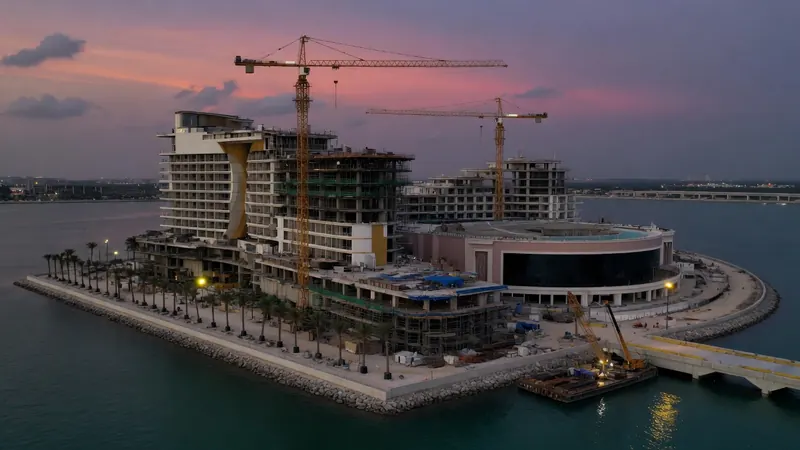
Wynn Resorts has confirmed that Wynn Al Marjan Island, the United Arab Emirates’ first licensed land-based casino resort, will open in Ras Al Khaimah in September 2027 after a roughly six-month delay from its earlier March target. The U.S.-Iran conflict added approximately $300 million in direct costs to the development, pushing its total budget to about $5.7 billion, company executives said in August. JPMorgan has told investors that concerns about the UAE project are exaggerated, while Wolfe Research argued the resort could beat the UAE’s gross gaming revenue targets by benchmarking against Singapore.
Opening Date Moves to September 2027
Wynn Resorts disclosed the new timetable on an August 4 quarterly call, with CEO Craig Billings saying construction is progressing rapidly and that the tower has topped out ahead of interior fit-out work. The company had previously signaled a modest delay in May, citing logistical and shipping challenges after U.S. and Israeli strikes on Iran in late February. Billings said the disruptions affected both timing and cost, and the project now has about 425 permanent hires as of the end of the second quarter, moving toward roughly 8,500 full-time employees at full operation. Chief financial officer Craig Fullalove said Wynn had contributed approximately $1.06 billion in cash to the project, with another $1.4 billion drawn under the loan.
War Costs Add $300 Million to $5.7 Billion Budget
The conflict-driven overrun is part of a $600 million increase, about half of which Billings said was directly traceable to the war, according to Wynn’s disclosures. Those direct costs included elevated marine war-risk insurance premiums in the Persian Gulf, supply chains rerouted or expedited around a disrupted Strait of Hormuz, and capitalized interest tied to the schedule shift. The remaining $300 million reflected normal remeasurement, trade coordination, and other costs expected on a project of this scale. TechTimes reported that maritime war-risk premiums surged from about 0.15 percent of a vessel’s value before the conflict to as high as 7.5 to 10 percent at peak. Wynn briefly suspended construction after drone debris landed in Al Hamra Village, around 15 kilometers from the site, on March 2; no injuries were reported and work restarted on March 11.
JPMorgan Says UAE Concerns Are Exaggerated
JPMorgan equity research said investor worries about the UAE casino are overblown after analysts met Wynn management at the Global Gaming Expo. Wynn management remains confident in its base-to-high case steady-state assumptions, and the bank highlighted that industry forecasts indicate the UAE could generate $3 billion to $5 billion in annual gross gaming revenue once additional integrated resorts are licensed. The company also believes regional instability could extend its exclusivity period because UAE authorities may slow approvals for competing gaming licenses. JPMorgan noted that Ras Al Khaimah welcomed 670,000 visitors in the first half of the year despite the conflict. The bank said Wynn shares have fallen more than 36 percent year-to-date mostly because of Macau weakness, where September was the fourth consecutive month of gross gaming revenue declines, and it sees upside from the $950 million Enclave second hotel tower at Wynn Palace.
Wolfe Research Draws Singapore Parallel
Wolfe Research analyst Peter Supino said the UAE market could follow Singapore’s trajectory. “Benchmarking against Singapore, another wealthy limited license casino market popular with tourists, suggests Wynn’s Al Marjan could beat the UAE GGR targets it laid out in December 2025,” Supino wrote. Singapore has just two integrated resorts, while the most ambitious UAE forecasts point to no more than four or five casino resorts. Wynn has said its venue could generate as much as $1.66 billion in annual GGR when fully ramped, with adjusted EBITDA between $390 million and $570 million. Supino also noted Knight Frank data that 43 percent of the UAE’s upcoming hotel room supply through 2030 is classified as luxury and that one-third of the world’s population lives within a four-hour flight of the UAE.
Physical Scope and Analyst Ratings
The resort occupies more than 60 hectares on Al Marjan Island, about 80 kilometers north of Dubai International Airport, and includes a 70-story tower, 22 restaurants, bars and lounges, a beach club, spa, pools, and a full-service marina, according to Wynn. The gaming floor is about 224,000 square feet, roughly 10,000 square feet larger than Wynn Las Vegas. Billings argued the September timing is strategically favorable because it coincides with the UAE’s peak tourism season, and he said demand should exceed supply for the core gaming product given the monopoly position. Deutsche Bank analyst Steven Pizzella called the confirmed opening date a positive step, while Citigroup maintained a buy rating and Deutsche Bank kept a $137 price target; Bain previously initiated coverage with a buy at $155.